
Every society that has successfully defined its direction—culturally, intellectually, and developmentally—has relied on a center of gravity. Not a political or military anchor, but a deeper force that shapes how people see themselves, how they learn, and how they imagine their future.
For South Sudan, that center of gravity is still emerging. It does not yet exist at a scale large enough to unify aspirations or amplify the nation’s creative and intellectual potential.
But one sector holds the power to create it: media.
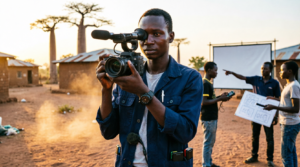
Across Africa and around the world, media industries—film, radio, television, digital storytelling, and educational content—are shaping national identities and fueling economic growth. South Sudan stands at the threshold of this possibility, and EduFilm is working to help unlock it.
The Missing Anchor: Why South Sudan Needs a Media Center of Gravity
South Sudan is rich in culture, history, languages, and artistic expression. Its cattle cultures are globally recognized; its oral traditions are among the oldest and strongest in the region; its youth are digitally connected and creatively ambitious.
Yet the country lacks a unified platform that ties these elements together into:
-
A shared story
-
A shared educational experience
-
A shared sense of cultural pride
-
A shared vision for the future
This is what mature media ecosystems do.
The Numbers Tell the Story
-
Radio reaches over 70% of South Sudanese households (UNESCO, 2023).
-
Over 72% of the population is under the age of 30, making South Sudan one of the youngest nations on earth.
-
Only 35% of adults are literate, and over 2.8 million children are currently out of school.
-
Fewer than 15 feature-length films are produced annually in South Sudan.
-
Less than 20% of media content consumed is locally produced (Internews, 2023).
-
Educational films can improve learning outcomes by 40–60%, compared with text-only instruction (World Bank).
-
Digital learning video can improve comprehension among early-grade learners by up to 80%.
These numbers point to one conclusion:
South Sudan needs an educational and cultural engine that can scale where schools alone cannot and reach youth where traditional systems struggle.
That engine is media.
Media as a Tool for Education
South Sudan faces one of the largest education gaps in the world:
-
A massive teacher shortage exceeding 30,000 instructors
-
Millions of learners outside the classroom
-
Limited access to learning materials
Media can multiply the reach of education faster and more cost-effectively than any physical infrastructure.
A single educational documentary can reach thousands through:
-
Community screenings
-
Mobile cinema
-
Radio adaptations
-
Digital platforms
-
School partnerships
In countries with low literacy and limited educational access, educational media dramatically accelerates learning, making it a powerful equalizer.
This is why EduFilm emphasizes film, digital content, and accessible learning tools as a national asset.
Media as a Guardian of Culture
South Sudan possesses world-class cultural heritage, but:
-
Less than 5% of cultural archives are digitized or documented (British Library Review, 2022).
-
Most cultural storytelling remains oral, vulnerable to loss.
-
Youth increasingly consume globalized content that does not reflect their identity.
Documentaries, digital archives, cultural films, and heritage-based storytelling can preserve traditions that risk disappearing.
Producing films on pastoral life, indigenous knowledge systems, naming cultures, music, dance, crafts, and everyday stories builds a shared cultural consciousness. These stories become the backbone of national pride and continuity.
Media as an Economic Driver
Africa’s creative sector is projected to reach $20 billion by 2030. Nigeria’s Nollywood alone:
-
Produces over 2,500 films per year
-
Generates ₦700 billion ($1.8 billion) annually
-
Employs more people than the oil sector
South Sudan’s creative economy is still small, but the potential is enormous:
-
A single documentary film can employ 20–30 young professionals
-
Media training creates jobs in editing, cinematography, sound, acting, animation, and design
-
Local productions keep revenue inside the country
-
A vibrant media ecosystem attracts investment, tourism, and partnerships
EduFilm’s mission aligns directly with this potential—building skills, producing world-class content, and showcasing South Sudanese talent globally.
EduFilm’s Vision: Media as the Nation’s Intellectual Infrastructure
EduFilm was built on the belief that storytelling is not entertainment alone—it is infrastructure.
Media shapes:
-
What people believe is possible
-
How children learn
-
How communities see themselves
-
How nations evolve
Our work—whether producing documentaries, developing educational films, training young creators, or researching media’s impact—centers around one idea:
Media should become South Sudan’s center of gravity.
Not by replacing institutions.
Not by competing with schools.
But by strengthening them.
Media connects stories.
Media multiplies knowledge.
Media accelerates development.
Media preserves identity.
With sustained investment and vision, South Sudan can build a media sector that educates, elevates, inspires, and unifies its people.
This is the future EduFilm is working toward.
And it is a future within reach.
Join the Film Education
Help us train the next generation of African storytellers and change-makers. Your support enables EduFilm to expand our programs and reach more communities across Africa.