
When communities are fractured by violence, displacement, and long histories of mistrust, rebuilding relationships requires more than policy agreements or public statements. Peacebuilding through film and community storytelling creates shared spaces where people can listen, witness, and begin to imagine one another again as neighbours rather than enemies, making it one of the most promising culturally grounded tools for reconciliation in conflict-affected societies.
Across Africa, practitioners are increasingly using film, theatre, and storytelling to support reconciliation, collective healing, and locally rooted dialogue. EduFilm places this approach at the centre of its work, using film, media, and storytelling as tools for education, advocacy, social impact, and peacebuilding and social cohesion while collaborating with communities to ensure authentic narratives rather than outsider interpretations.
Why Peacebuilding Through Film and Community Storytelling Matters
Turning Dialogue Into Something People Can See and Feel
Film has unusual power in peacebuilding because it works simultaneously on emotional, social, and civic levels. A well-told story allows viewers to encounter lived experience rather than abstract argument, helping communities move from accusation toward recognition. UNESCO describes dialogue not as a symbolic add-on, but as a practical tool for rebuilding trust, fostering shared understanding, and transforming fractured social relations; it specifically highlights creative mediums such as film, theatre, and storytelling as valuable for reconciliation and collective healing.
Beyond Statements, Toward Shared Human Experience
Traditional peace efforts often focus on formal negotiations, elite mediation, and institutional reform. Those efforts matter, but they do not always create the local spaces needed for ordinary people to process grief, hear one another, and rebuild social trust. Community storytelling helps fill that gap by making room for memory, dignity, and local participation, while film gives those stories visibility and emotional force that can travel far beyond a single meeting room.
Research on arts in reconciliation and peacebuilding in Africa concludes that arts-based approaches can promote healing, reconciliation, social cohesion, and social transformation when they are locally led and rooted in cultural traditions. That conclusion is especially important for film-based peacebuilding, because the most effective stories are rarely imposed from outside; they emerge from the voices, memories, and cultural frameworks of the communities most affected by conflict.
Community Storytelling as a Foundation for Trust
Community storytelling is not only about documenting suffering. It is also about restoring agency. When survivors, youth, elders, women, and displaced people can shape how their communities are represented, storytelling becomes a civic act. It creates space for multiple truths to coexist, interrupts one-sided narratives, and allows people to see that pain has not been carried by only one group. This kind of shared witnessing can become the first step toward dialogue that is less defensive and more honest.
The process itself also matters. Story circles, participatory interviews, local screenings, and facilitated discussions can help communities move from passive consumption to collective reflection. Instead of treating peace as a distant policy goal, storytelling makes peace tangible and relational: it happens when people sit together, watch together, and speak together about what they have seen.
“Far from a symbolic gesture, dialogue is a practical, adaptive tool for rebuilding trust, fostering shared understanding, and transforming fractured social relations.” — UNESCO, Promoting Dialogue for Conflict Transformation
Evidence That Film Can Strengthen Peace at Community Level
Across the continent and beyond, arts-based peacebuilding has gained credibility because it addresses the human relationships underneath public conflict. The strongest evidence does not suggest that film replaces political solutions; rather, it shows that storytelling can strengthen the social foundations without which formal peace agreements often remain fragile. Arts and cultural programmes are most effective when they are integrated into broader efforts linking culture, security, and development to sustainable peace.
Liberia’s Reel Peace Project
One of the most concrete examples comes from Liberia’s Reel Peace project, evaluated by the United Nations Peacebuilding Fund. The project trained 45 Liberian women filmmakers across 15 counties, produced 15 stories, and held a national women’s film festival attended by 530 people. The films were then distributed to 300 video clubs across the country to stimulate discussion and dialogue.
What makes Reel Peace especially relevant is not only the number of films produced, but the way storytelling became a platform for participation and public conversation. The evaluation found that the initiative created a network of female storytellers, expanded peace-oriented media production, and achieved an overall 98% activity completion rate. This shows that film can function not merely as a communication output, but as an organized peacebuilding process in its own right. You can view from this source
What the Evidence Suggests
The wider research base supports the idea behind projects like Reel Peace: film and other arts-based approaches can contribute to healing and reconciliation when they are community-led, culturally grounded, and protected from propaganda or hidden political agendas. In other words, storytelling builds peace most effectively when it expands trust rather than manipulates emotion, and when communities remain authors of their own narratives.
EduFilm’s Role in Community-Led Peace Storytelling
EduFilm’s work is especially well positioned within this field because it already combines several of the elements that research and practice identify as essential: authentic local narratives, media capacity building, advocacy storytelling, and community collaboration. On its Our Work page, EduFilm explains that it does not create content for the sake of content, but to create change, amplify local voices, and build media capacity where it is needed most. That mission aligns directly with peacebuilding through storytelling, where process and participation are as important as the final film.
Authentic Narratives, Not Outsider Interpretations
Peace storytelling fails when it speaks about communities without speaking with them. EduFilm emphasizes collaboration with NGOs, grassroots groups, and communities so that stories remain authentic and locally grounded. This matters in conflict-affected settings, where representation can either deepen mistrust or help restore dignity. Community storytelling becomes peacebuilding when people recognize themselves in the story and trust the process by which it was made. [Source](https://edufilm.org/our-work/)
Training Storytellers as Peacebuilders
EduFilm’s training and media capacity building programmes include filmmaking, storytelling for advocacy, documentary production, editing, and community media labs. These skills are not only creative tools; they are peace infrastructure. When youth and emerging storytellers learn how to document experience responsibly, facilitate conversation, and communicate across difference, they become local peace actors capable of shaping public narratives in healthier ways.
Preserving Memory While Building the Future
EduFilm also works in cultural documentation and story archives, capturing oral histories, heritage, identity, music, dance, and folklore through visual media. In peacebuilding terms, this is deeply significant. Communities recovering from conflict need not only future-oriented hope, but also dignified ways of preserving memory. Storytelling helps ensure that culture is not erased, misrepresented, or forgotten, and that peace is built on recognition rather than amnesia.
From Screening to Social Cohesion
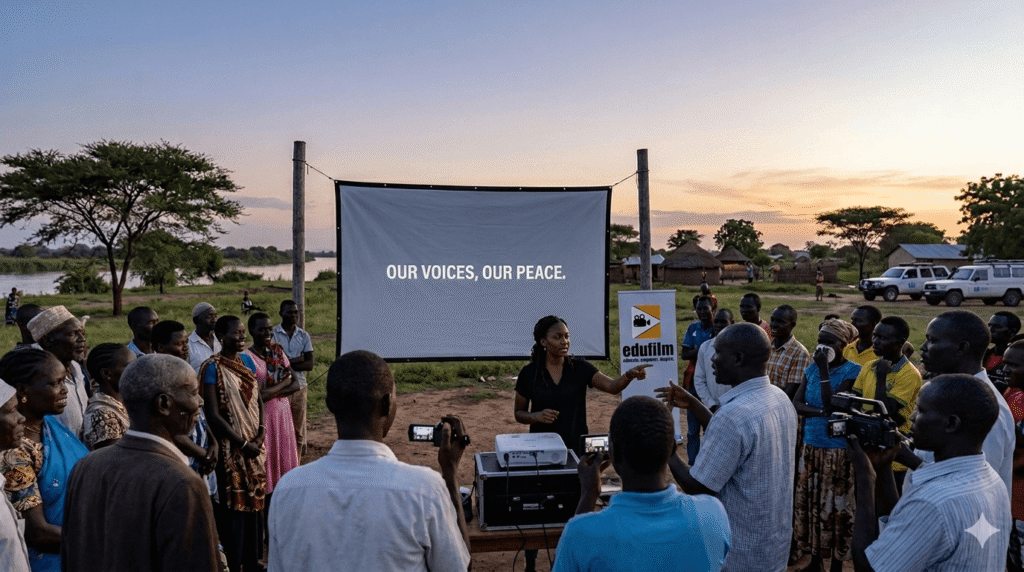
Film becomes most powerful in peacebuilding when it does not end with the credits. Community screenings create temporary public spaces where people can gather around a shared narrative, often lowering the emotional barriers that make direct conversation difficult. With thoughtful facilitation, screenings can open discussions about memory, accountability, coexistence, identity, and common aspirations in ways that feel safer and more structured than unmediated debate.
Why Local Ownership Matters
Research on arts in peacebuilding repeatedly stresses that local leadership is not optional. Community-led storytelling is more credible, more culturally resonant, and more sustainable than messaging imposed from outside. It is also more likely to create durable social cohesion because people do not simply consume a peace message; they participate in making it, interpreting it, and carrying it forward into everyday relationships.
Writing New Stories Together
In places where conflict has taught communities to fear one another, storytelling can offer a different script. It can make room for grief without glorifying grievance, preserve memory without hardening hatred, and support dialogue without erasing difference. Peacebuilding through film is therefore not just about production quality or awareness campaigns. It is about creating the conditions in which people can once again imagine a shared future.
Peacebuilding through film and community storytelling is not a shortcut around the hard work of justice, policy, and social repair. But it is a powerful companion to that work because it addresses the level where conflict often lives longest: in memory, perception, identity, and everyday relationships. EduFilm’s approach to film, media, and storytelling shows how local voices, visual narratives, and community participation can become practical tools for rebuilding trust and strengthening social cohesion in South Sudan and beyond.
Support Peacebuilding Through Storytelling
Help EduFilm expand community-led film and storytelling programmes that build trust, preserve memory, and strengthen social cohesion. Your support helps equip local storytellers, train young filmmakers, and bring dialogue-centered screenings to the communities that need them most.